

Small business payroll problems arise not from complexity alone but from treating payroll as a clerical task instead of a strategic system. Designing payroll as scalable infrastructure reduces legal risk, protects cash flow, and supports sustainable hiring.
If you run a small business, the direct answer is this: payroll management means accurately calculating pay, withholding and remitting taxes, complying with labor laws, and maintaining records—on a strict schedule. Do it wrong and you risk penalties, lawsuits, cash-flow shocks, and employee distrust. Do it right and payroll becomes a stable backbone for growth.
Most founders begin with informal methods—spreadsheets, ad-hoc transfers, or relying on an accountant once a year. That works temporarily. But as your team grows, payroll complexity accelerates: overtime rules, multiple pay types, benefits deductions, tax deposits, reporting deadlines, and data security requirements. Mistakes don’t stay small. They compound.
Why Payroll Is One of the Highest-Risk Functions in a Small Business
Payroll mistakes affect governments, employees, and your finances simultaneously. Agencies such as the Internal Revenue Service enforce strict tax compliance, while labor rules may be overseen by bodies like the U.S. Department of Labor. In many countries, payroll errors are among the most common reasons small firms face penalties or audits.
What makes payroll especially risky is that problems often surface months later, when fixing them is far more expensive.
How Risk Scales with Growth
| Business Stage | Typical Payroll Method | Hidden Risk | Likely Failure Point |
| 1–3 employees | Manual spreadsheet | Human error | Missed deductions |
| 5–10 employees | Semi-manual | Overtime complexity | Compliance gaps |
| 10–25 employees | Software adoption | Incorrect setup | Filing errors |
| Multi-location | Mixed systems | Legal variation | Penalties, audits |
A system that worked for a micro-team rarely survives expansion.
What Payroll Management Really Includes
Payroll is not just paying salaries—it is a cycle of calculations, payments, reporting, and record-keeping.
| Payroll Component | What It Involves | Why It Matters |
| Pay calculation | Wages, overtime, bonuses | Ensures legal pay |
| Tax withholding | Income taxes, social contributions | Compliance |
| Employer taxes | Additional payroll liabilities | True hiring cost |
| Benefits deductions | Insurance, retirement | Employee retention |
| Reporting | Government filings | Legal obligation |
| Records | Payslips, time data | Audit protection |
Because payroll touches finance, HR, and law, responsibility cannot be siloed without coordination.
End-to-End Payroll Workflow Explained
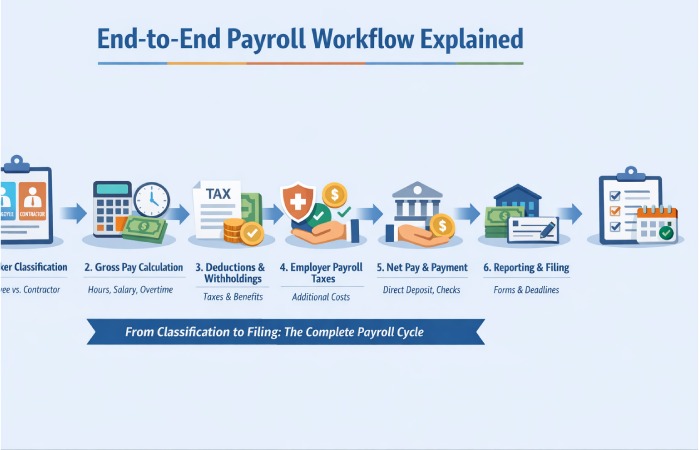
Understanding the full workflow helps prevent gaps.
Worker Classification: Employee vs Contractor
Misclassification is one of the most expensive payroll mistakes.
| Factor | Employee | Contractor |
| Work control | Employer directs work | Independent control |
| Benefits | Often required | Typically none |
| Tax withholding | Employer withholds | Contractor handles own |
| Legal protections | High | Limited |
Illustrative example: A startup hires full-time “contractors” to save costs. Later reclassification forces back taxes and penalties.
Gross Pay Calculation
Gross pay depends on compensation structure.
| Pay Type | Calculation Basis | Common Pitfall |
| Hourly | Hours × rate | Inaccurate time tracking |
| Salary | Fixed per period | Misallocating partial periods |
| Overtime | Premium rates | Ignoring legal thresholds |
| Commission | Performance-based | Delayed payouts |
Errors here ripple through every subsequent step.
Deductions and Withholdings
Payroll deductions fall into two categories.
| Deduction Type | Examples | Mandatory? |
| Statutory | Income tax, social insurance | Yes |
| Voluntary | Health insurance, retirement | No |
| Legal orders | Garnishments | Yes when applicable |
Incorrect deductions can lead to underpayment penalties or employee disputes.
Employer Payroll Taxes
Employers incur additional costs beyond gross pay.
| Cost Component | Who Pays | Impact |
| Social contributions | Employer + employee | Increases labor cost |
| Unemployment insurance | Employer | Mandatory in many regions |
| Local levies | Employer | Varies by jurisdiction |
This is why a salary offer understates the true cost of hiring.
Net Pay and Delivery
Net pay is what employees actually receive after deductions.
| Payment Method | Advantages | Limitations |
| Direct deposit | Fast, traceable | Requires bank info |
| Paper check | Universal | Processing delay |
| Pay card | Useful for unbanked workers | Fees possible |
Reporting and Filings
Payroll continues after payday.
| Reporting Type | Frequency | Purpose |
| Tax deposits | Monthly/quarterly | Government funding |
| Payroll returns | Periodic | Compliance reporting |
| Year-end statements | Annual | Employee tax filing |
Legal and Compliance Requirements Simplified
Requirements vary globally but share core elements:
- Employer registration
- Tax withholding and remittance
- Social security contributions
- Worker protection compliance
- Record retention
For example:
| Region | Key Obligations |
| United States | Federal + state payroll taxes |
| United Kingdom | PAYE via HMRC |
| India | EPF, ESI, TDS systems |
This guide is educational, not legal advice.
Payroll System Options for Small Businesses
Small businesses typically choose among three models.
Manual Payroll
Suitable only for very small teams.
| Pros | Cons | Best Use Case |
| Low cost | High error risk | 1–2 employees |
| Full control | Time-consuming | Very simple pay |
| No software fees | No automation | Temporary setup |
Payroll Software
Tools from companies such as Gusto, QuickBooks, ADP, and Paychex automate calculations and filings.
| Benefits | Limitations | Ideal For |
| Automated taxes | Subscription cost | Growing SMBs |
| Direct deposit | Setup required | Multi-employee teams |
| Compliance alerts | Learning curve | Scaling operations |
Fully Outsourced Payroll
External specialists manage payroll entirely.
| Advantages | Drawbacks | When to Choose |
| Minimal workload | Higher cost | Complex operations |
| Expert compliance | Less control | Multi-state teams |
| Audit support | Vendor dependency | Rapid growth |
Hybrid Approach
Software plus professional oversight.
| Strength | Weakness | Best Scenario |
| Balanced control | Coordination needed | Transition stage |
| Cost-effective | Shared responsibility | Small finance teams |
The True Cost of Payroll
Software pricing tells only part of the story.
| Cost Category | Examples | Often Overlooked? |
| Direct | Software fees, services | No |
| Indirect | Staff time | Yes |
| Error costs | Penalties, corrections | Yes |
| Opportunity cost | Time not spent on growth | Yes |
| Cash-flow impact | Payroll timing | Yes |
Cheap solutions can become expensive through mistakes.
Most Common Payroll Mistakes — and Prevention
| Mistake | Consequence | Prevention Strategy |
| Late tax deposits | Penalties + interest | Automated reminders |
| Misclassification | Back taxes | Legal review |
| Overtime errors | Wage disputes | Time tracking |
| Poor records | Audit risk | Organized storage |
| Ignoring local rules | Non-compliance | Periodic updates |
Failure patterns are predictable—prevention is cheaper than correction.
Payroll as a Cash-Flow Management System
Payroll is typically the largest recurring expense for a small business.
Illustrative Scenario
A seasonal company pays biweekly year-round but earns most revenue during peak months. Off-season payroll strains liquidity, forcing short-term borrowing.
Stabilization Strategies
| Strategy | How It Helps | Difficulty |
| Payroll reserve | Covers slow periods | Medium |
| Revenue-aligned cycles | Matches cash inflow | Medium |
| Liability forecasting | Prevents surprises | Low |
| Overtime control | Reduces spikes | Low |
Financially mature businesses plan payroll like any major capital commitment.
When to Upgrade Your Payroll Infrastructure
Outgrowing your system creates hidden risk.
| Trigger | Why Upgrade | Risk of Delay |
| Rapid hiring | Increased complexity | Errors multiply |
| Multiple locations | Legal variation | Compliance issues |
| Employee benefits | New deductions | Incorrect filings |
| Frequent corrections | System failure | Penalties |
Step-by-Step Payroll Setup Blueprint
| Step | Action | Purpose |
| 1 | Register as employer | Legal compliance |
| 2 | Set up tax accounts | Payment routing |
| 3 | Collect employee forms | Accurate withholding |
| 4 | Choose payroll model | System design |
| 5 | Test payroll run | Error detection |
| 6 | Create calendar | Deadline tracking |
Building correctly once prevents repeated fixes.
Payroll Governance, Controls, and Security
Payroll data includes sensitive financial information.
| Control Measure | Risk Mitigated |
| Access restrictions | Unauthorized changes |
| Approval workflows | Fraud |
| Audit trails | Undetected errors |
| Secure storage | Data breaches |
| Backups | Data loss |
Weak controls can cost far more than compliance penalties.
Ongoing Payroll Operations Checklist
| Frequency | Tasks |
| Each pay period | Verify hours, process pay |
| Monthly | Reconcile accounts |
| Quarterly | File reports |
| Annually | Issue statements |
Consistency ensures stability.
Future-Proofing Payroll for Growth
A scalable payroll system anticipates expansion.
| Preparation Area | Action | Benefit |
| Technology | Integrate systems | Efficiency |
| Policies | Standardize pay rules | Fairness |
| Documentation | Record procedures | Continuity |
| Compliance review | Periodic checks | Risk reduction |
Businesses that plan early avoid disruptive overhauls later.
Final Perspective
Payroll rarely attracts attention when it works—but failures quickly become crises. A reliable payroll system builds employee confidence, protects against regulatory trouble, and stabilizes finances.
Treat payroll not as routine administration but as core business infrastructure. When designed intentionally, it supports growth silently, enabling you to focus on strategy rather than firefighting.