

Introduction
In today’s fast-paced software development environment, delivering high-quality applications quickly is no longer optional—it is essential. Organizations are under constant pressure to release updates faster while maintaining reliability, performance, and user satisfaction. Traditional testing methods, whether manual or scripted automation, often struggle to keep up with these demands.
This is where Artificial Intelligence (AI) is making a significant impact. Incorporating AI into testing enables teams to shift their focus from repetitive, time-consuming tasks to more strategic and innovative aspects of development. AI-powered testing tools are transforming quality assurance (QA) processes by enhancing speed, accuracy, and efficiency.
AI testing tools leverage technologies such as machine learning (ML), natural language processing (NLP), and data analytics to optimize testing workflows. From generating intelligent test cases to predicting defects and enabling self-healing scripts, these tools are redefining how software is tested and delivered.
Emergence of AI in Test Automation
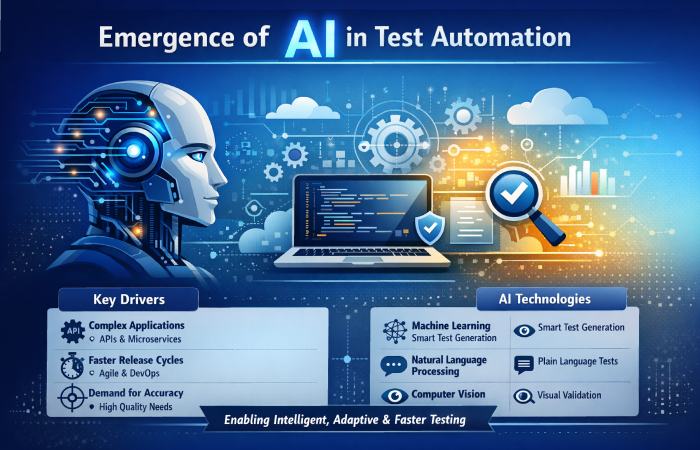
The rise of AI in test automation is driven by the increasing complexity of modern applications and the need for rapid delivery cycles. Agile and DevOps practices demand continuous integration and continuous delivery (CI/CD), where testing must happen quickly and continuously.
Traditional testing approaches often fail to adapt to:
- Rapid UI changes
- Frequent code deployments
- Complex user interactions
- Multi-platform environments
AI bridges these gaps by introducing intelligent automation capabilities.
Key Drivers of AI Adoption in Testing
| Factor | Description |
| Increasing Application Complexity | Modern apps involve APIs, microservices, and dynamic UIs |
| Faster Release Cycles | Agile and DevOps require continuous testing |
| Need for Accuracy | Manual testing is prone to human error |
| Maintenance Challenges | Scripted tests break frequently with UI changes |
| Demand for Scalability | Testing across devices and platforms requires automation |
AI technologies such as computer vision, NLP, and machine learning allow systems to learn from past data, adapt to changes, and make informed decisions during testing.
Understanding AI Test Tools
AI test tools are advanced software solutions designed to improve testing efficiency, accuracy, and coverage. They automate complex testing processes and provide intelligent insights that traditional tools cannot offer.
These tools are not limited to testing applications—they also validate AI/ML models themselves, ensuring reliability and robustness.
Core Capabilities of AI Test Tools
| Capability | Description |
| Intelligent Automation | Automates repetitive and complex tasks |
| Predictive Analysis | Identifies potential failure points |
| Self-Learning Systems | Improves performance over time |
| Data-Driven Testing | Uses historical data for better decisions |
| Cross-Platform Support | Ensures compatibility across devices |
AI tools enhance the entire testing lifecycle—from test creation to execution and analysis.
Key Features of AI Test Tools
AI test tools offer a wide range of advanced features that significantly improve testing processes.
Feature Overview
| Feature | Description | Benefit |
| Automated Test Case Generation | Creates test cases using data and behavior analysis | Saves time and improves coverage |
| Self-Healing Scripts | Automatically updates broken test scripts | Reduces maintenance effort |
| Visual Testing | Detects UI inconsistencies | Ensures better user experience |
| Test Prioritization | Focuses on high-risk areas | Improves efficiency |
| NLP-Based Testing | Allows plain language test creation | Makes testing accessible |
| Anomaly Detection | Identifies unusual system behavior | Prevents failures |
| Performance Optimization | Detects inefficiencies | Enhances system performance |
| AI Analytics | Provides insights and predictions | Improves decision-making |
| Regression Testing | Automates repeated testing cycles | Ensures stability |
| Cross-Platform Testing | Tests across browsers/devices | Expands coverage |
| CI/CD Integration | Integrates with pipelines | Enables continuous testing |
| Error Clustering | Groups similar issues | Simplifies debugging |
Benefits of Integrating AI in Test Automation
AI-powered testing tools bring intelligence and adaptability into automation strategies, making them more efficient and reliable.
Benefits Breakdown
| Benefit | Explanation |
| Enhanced Test Coverage | AI generates comprehensive scenarios |
| Faster Execution | Parallel and automated testing speeds up processes |
| Reduced Maintenance | Self-healing scripts minimize manual updates |
| Better Accuracy | AI reduces human error |
| Predictive Defect Detection | Identifies issues before they occur |
| Improved User Experience | Simulates real user interactions |
| Scalability | Handles large and complex applications |
| Continuous Testing | Supports DevOps workflows |
Detailed Explanation
AI improves test coverage by analyzing user behavior and historical data to generate meaningful test cases. This reduces the risk of missing critical scenarios.
Dynamic updates ensure that test scripts remain relevant even when applications change. Instead of rewriting scripts manually, AI adapts them automatically.
Another major advantage is defect prediction. AI identifies patterns in code and testing data to forecast where issues are most likely to occur. This allows teams to focus on high-risk areas and resolve problems proactively.
AI also enhances user experience testing by simulating real-world interactions. It evaluates usability, responsiveness, and performance from a user’s perspective.
Top AI Test Tools to Enhance Automation Strategy
Below are some of the most effective AI-powered testing tools available today.
Tools Comparison
| Tool | Type | Best For | Key Strength |
| KaneAI | GenAI QA Platform | Fast automation setup | Natural language testing |
| Selenium | Open-source | Flexible automation | Strong community support |
| Testim | AI Automation Tool | Stable testing | Self-healing scripts |
| Selenium + AI Plugins | Enhanced framework | Existing Selenium users | AI integration |
| Functionize | Cloud AI Testing | End-to-end testing | NLP-based automation |
Detailed Tool Insights
KaneAI
KaneAI is a next-generation AI-powered testing assistant that simplifies automation using natural language. It allows both technical and non-technical users to create and manage test cases efficiently.
| Feature | Description |
| Natural Language Testing | Write tests in plain English |
| Self-Healing Automation | Automatically fixes broken scripts |
| CI/CD Integration | Works with Jenkins, GitHub Actions |
| Cross-Browser Testing | Supports thousands of environments |
| Accessibility Testing | Ensures compliance with standards |
Selenium
Selenium remains one of the most widely used automation frameworks, now enhanced with AI capabilities.
| Feature | Description |
| Open Source | Free and highly customizable |
| AI Integration | Improves element detection |
| Visual Testing | Supports UI validation |
| Cross-Browser Support | Works across multiple browsers |
Testim
Testim focuses on stability and scalability using AI-driven automation.
| Feature | Description |
| Self-Healing Tests | Reduces flaky tests |
| Reusable Components | Improves efficiency |
| NLP Support | Simplifies test creation |
| Cross-Platform Testing | Ensures compatibility |
Selenium with AI Plugins
For teams already using Selenium, AI plugins enhance its capabilities without requiring a complete transition.
| Feature | Description |
| AI Element Detection | Improves accuracy |
| Self-Healing Scripts | Adapts to UI changes |
| Scalability | Supports large test suites |
| Visual Testing | Enhances UI validation |
Functionize
Functionize is a cloud-based AI testing platform designed for end-to-end automation.
| Feature | Description |
| NLP-Based Testing | Easy test creation |
| Centralized Management | Manages all tests in one place |
| Visual Validation | Ensures UI consistency |
| CI/CD Integration | Supports continuous testing |
Choosing the Right AI Test Tool
Selecting the right AI test tool depends on various factors, including team expertise, project requirements, and long-term goals.
Selection Criteria
| Criteria | Consideration |
| Ease of Use | Does it support low-code or no-code testing? |
| Integration | Can it integrate with CI/CD pipelines? |
| Scalability | Can it handle large applications? |
| Cost | Does it fit the budget? |
| Flexibility | Is it customizable? |
| Support | Is there strong community or vendor support? |
Recommendations Based on Use Case
| Use Case | Recommended Tool |
| Beginner-Friendly | KaneAI |
| Open-Source Flexibility | Selenium |
| Stable Automation | Testim |
| Existing Selenium Users | Selenium + AI Plugins |
| Enterprise Solutions | Functionize |
Future of AI in Testing
AI in testing is still evolving, and its future looks promising. Emerging trends include:
- Autonomous testing systems
- AI-driven test orchestration
- Advanced predictive analytics
- Voice and conversational testing
- Hyper-personalized user experience testing
These advancements will further reduce manual effort and improve testing accuracy.
Conclusion