

Introduction
Digital transformation has reshaped the way businesses interact with their customers. Traditional customer support channels such as phone calls and physical service desks are no longer sufficient to meet modern customer expectations. Today’s consumers prefer faster, more convenient communication methods such as live chat, email, social media messaging, and mobile applications. This shift has led to the growing importance of digital customer service.
Digital customer service refers to providing support through digital channels and technologies, allowing businesses to assist customers quickly and efficiently. By using tools such as AI chatbots, helpdesk software, and CRM platforms, companies can manage thousands of customer interactions simultaneously while delivering personalized experiences.
Modern businesses are adopting omnichannel strategies where customers can switch between channels—such as website chat, social media, or email—without losing context. According to research, 57% of customers prefer digital service channels instead of phone support, and many customers expect businesses to offer support through multiple platforms.
As digital communication continues to expand, organizations must integrate advanced technologies to improve customer experience, reduce service costs, and build long-term customer loyalty.
What is Digital Customer Service?
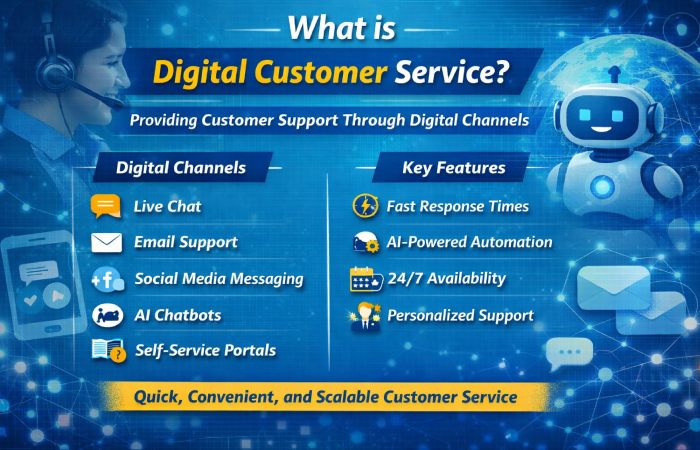
Digital customer service is the practice of providing customer support through digital communication channels rather than traditional in-person or phone-based methods. These digital channels include email, live chat, social media platforms, messaging apps, mobile applications, and automated AI assistants.
Unlike traditional customer support systems where agents handle one call at a time, digital channels allow support agents to manage multiple conversations simultaneously. This significantly increases productivity and reduces response time.
According to customer service research, digital customer service enables businesses to provide quick, convenient, and personalized interactions using technologies such as chatbots, automated workflows, and CRM systems.
Digital vs Traditional Customer Service
| Feature | Traditional Customer Service | Digital Customer Service |
| Communication Channels | Phone, in-person | Chat, email, social media |
| Response Time | Slower due to queues | Faster responses |
| Availability | Limited business hours | Often 24/7 |
| Automation | Minimal | AI-powered automation |
| Scalability | Limited | Highly scalable |
Common Digital Support Channels
| Channel | Purpose |
| Live Chat | Instant support through websites |
| Email Support | Detailed responses to customer inquiries |
| Social Media Messaging | Quick responses on platforms like Facebook or Instagram |
| Chatbots | Automated answers to frequently asked questions |
| Self-Service Portals | Knowledge bases and help centers |
Digital customer service has become the foundation of modern customer experience strategies.
Why Do Customers Want Digital Customer Service?

Customer expectations have changed significantly due to technological advancements. Consumers now expect businesses to provide fast, convenient, and accessible support across multiple channels.
Many customers prefer digital support because it allows them to communicate with companies anytime and from anywhere. Digital platforms also eliminate long waiting times associated with traditional call centers.
Studies show that 74% of customers expect businesses to offer online options for services that were previously handled in person or by phone.
Key Reasons Customers Prefer Digital Support
| Reason | Explanation |
| Convenience | Customers can contact businesses anytime |
| Faster Responses | Live chat and chatbots provide instant answers |
| Multiple Channels | Users can choose their preferred communication method |
| Personalized Service | Businesses can use customer data to personalize responses |
| Self-Service Options | Customers can solve problems independently |
Customer Behavior in Digital Support
| Customer Behavior | Impact on Businesses |
| Customers use multiple channels | Businesses must adopt omnichannel strategies |
| Customers expect quick responses | Companies need automated tools |
| Customers prefer mobile support | Businesses must optimize for mobile devices |
| Customers value personalization | CRM systems become essential |
Digital service provides flexibility and convenience that traditional customer service cannot match.
Why Should Your Business Offer Digital Customer Service?
Businesses that fail to implement digital customer service risk losing customers to competitors who provide better digital experiences.
Digital service systems help companies streamline operations while improving customer satisfaction. Since digital channels allow agents to handle several conversations simultaneously, businesses can serve more customers with fewer resources.
Business Advantages of Digital Customer Service
| Advantage | Description |
| Improved Efficiency | Agents can handle multiple inquiries simultaneously |
| Cost Reduction | Automation reduces operational expenses |
| Better Customer Experience | Faster and personalized responses |
| Higher Customer Retention | Satisfied customers remain loyal |
| Competitive Advantage | Businesses stay ahead in digital markets |
Business Impact of Digital Service
| Business Metric | Effect of Digital Service |
| Customer Satisfaction | Increases significantly |
| Support Costs | Decreases through automation |
| Response Time | Reduced dramatically |
| Productivity | Higher agent efficiency |
| Customer Loyalty | Stronger long-term relationships |
Businesses that adopt digital support solutions can improve both operational efficiency and customer experience.
Benefits of Digital Customer Service
Digital customer service provides multiple benefits that improve both business operations and customer experiences.
One major advantage is improved productivity. Digital platforms allow support agents to handle multiple conversations simultaneously, unlike phone calls that require one-to-one interaction.
Another benefit is reduced operational costs because automation tools such as chatbots can handle repetitive queries without human intervention.
Core Benefits of Digital Customer Service
| Benefit | Description |
| Faster Response Time | Instant replies through chat and automation |
| Improved Agent Productivity | Agents manage multiple interactions |
| Reduced Costs | Lower staffing and infrastructure costs |
| Scalability | Businesses can support large customer volumes |
| Better Data Insights | Customer data improves decision-making |
Long-Term Business Benefits
| Benefit | Impact |
| Improved Customer Loyalty | Customers trust brands with quick support |
| Increased Revenue | Better service leads to repeat purchases |
| Enhanced Brand Reputation | Positive customer experiences improve brand image |
| Operational Efficiency | Streamlined workflows |
Companies with strong omnichannel strategies can even achieve significantly higher revenue growth compared to those with weak digital service strategies.
Digital Customer Service Tools You Need
Implementing digital customer service requires specialized software tools that help businesses manage customer interactions across multiple channels.
These tools automate support processes, track customer data, and organize service requests efficiently.
Essential Digital Customer Service Tools
| Tool | Purpose |
| Helpdesk Software | Manage customer tickets |
| CRM Systems | Store and track customer data |
| Live Chat Platforms | Provide instant customer support |
| AI Chatbots | Automate repetitive questions |
| Social Media Management Tools | Respond to social media inquiries |
Popular Customer Service Platforms
| Platform | Starting Price | Key Feature |
| Zendesk | $19 per agent/month | AI-powered support system |
| Intercom | $29 per seat/month | Conversational customer messaging |
| Salesforce Service Cloud | $25 per user/month | CRM-based support platform |
| Zoho Desk | $7 per user/month | Affordable helpdesk solution |
| Freshdesk | $15 per agent/month | AI automation and ticket management |
Pricing and features vary depending on the size of the business and the level of automation required.
How to Improve Digital Customer Service
Improving digital customer service requires a strategic approach that combines technology, trained support teams, and customer feedback.
Businesses must continuously analyze customer interactions and optimize their support systems.
Steps to Improve Digital Customer Service
| Step | Description |
| Implement Live Chat | Provide instant communication |
| Use AI Chatbots | Automate common questions |
| Create Knowledge Bases | Enable self-service support |
| Train Support Agents | Improve communication skills |
| Monitor Performance Metrics | Measure response time and satisfaction |
Best Practices
| Practice | Benefit |
| Personalize customer interactions | Improves satisfaction |
| Respond quickly | Reduces frustration |
| Offer omnichannel support | Provides seamless experiences |
| Use analytics tools | Helps identify customer needs |
Businesses should also collect feedback regularly to understand customer pain points.
Digital Customer Service Companies in India and USA
Several technology companies provide digital customer service platforms and solutions.
Top Companies in India
| Company | Location | Service |
| Freshworks | Chennai | Customer support software |
| Zoho | Chennai | CRM and helpdesk systems |
| Yellow.ai | Bengaluru | AI chatbot solutions |
| Haptik | Mumbai | Conversational AI platform |
Top Companies in the USA
| Company | Location | Service |
| Zendesk | San Francisco | Customer service platform |
| Salesforce | California | CRM-based support system |
| Intercom | San Francisco | Messaging support software |
| HubSpot | Massachusetts | Customer service and CRM tools |
These companies provide tools that enable businesses to automate support, track customer interactions, and deliver omnichannel service experiences.
Digital Customer Service in India and USA
Digital customer service adoption is increasing rapidly in both India and the United States.
India has become a global hub for customer support outsourcing due to its skilled workforce and lower operational costs. Many multinational companies outsource digital customer service operations to India.
Digital Customer Service Landscape
| Factor | India | USA |
| Market Growth | Rapidly expanding | Mature market |
| Technology Adoption | Increasing AI adoption | Highly advanced |
| Labor Costs | Lower | Higher |
| Outsourcing Industry | Strong | Limited |
India’s growing IT sector continues to drive innovation in digital support technologies.
Digital Customer Service Prices in India and USA
Digital customer service pricing varies depending on the tools, automation features, and number of users.
Pricing in India
| Service Type | Monthly Cost |
| Basic Helpdesk Software | $7 – $20 per user |
| CRM Customer Support | $30 – $60 per user |
| AI Chatbot Solutions | $100 – $400 |
Pricing in the USA
| Service Type | Monthly Cost |
| Basic Customer Support Tools | $25 – $70 per user |
| CRM Platforms | $80 – $150 per user |
| Enterprise AI Chatbots | $500 – $2000+ |
Businesses should select solutions based on their size, customer volume, and automation requirements.
Adopt Digital Customer Service Solutions to Improve Customer Satisfaction
Adopting digital customer service solutions can significantly improve customer satisfaction and operational efficiency.
Businesses that implement omnichannel support, AI automation, and CRM integration can deliver faster and more personalized service experiences.
Strategies for Implementing Digital Customer Service
| Strategy | Benefit |
| Omnichannel Support | Consistent experience across platforms |
| AI Automation | Faster responses |
| CRM Integration | Better customer insights |
| Self-Service Resources | Reduced support workload |
| Analytics Tools | Data-driven decision making |
Companies that leverage advanced digital tools can build stronger relationships with customers and enhance brand loyalty.
Conclusion
Digital customer service has become a crucial element of modern business success. As customers increasingly rely on digital channels for communication, businesses must adapt their service strategies accordingly.
By implementing technologies such as AI chatbots, CRM systems, and omnichannel support platforms, companies can provide faster responses, improve efficiency, and enhance customer experiences. Digital customer service also allows businesses to scale operations while reducing costs.
Organizations in both India and the United States are investing heavily in digital support systems to meet evolving customer expectations. As technology continues to advance, digital customer service will play an even more significant role in shaping the future of customer experience.