

Introduction
Growing social media followers only becomes profitable when paired with structured monetization systems, audience intent alignment, and trust-driven conversion strategies.
Most people assume that more followers automatically means more money. That belief is everywhere—driven by influencer culture, viral success stories, and platform hype. But here’s the uncomfortable truth: you can have thousands of followers and still earn almost nothing.
The core problem is not growth—it’s misunderstanding what growth actually does. Followers give you attention, not income. Attention is only valuable when it is converted into action. Without that system, follower growth becomes a vanity metric. With it, it becomes a scalable business asset.
The Follower-to-Revenue Framework
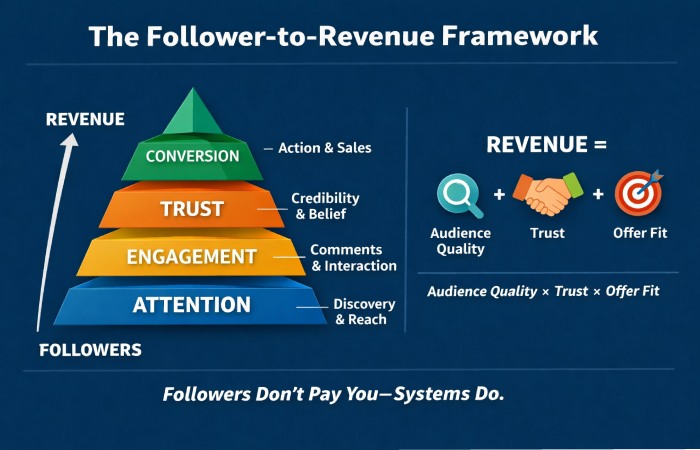
Most people think social media works like this: Post content → Gain followers → Earn money
But in reality, revenue emerges from a layered process that most creators ignore. Social media growth is just the first step in a multi-stage system that gradually transforms attention into trust and, eventually, into financial outcomes.
The 4-Layer Monetization Stack
| Layer | What Happens | Why It Matters |
|---|---|---|
| Attention | People discover your content | Entry point to growth |
| Engagement | Likes, comments, shares | Signals interest |
| Trust | Audience believes your expertise | Enables decisions |
| Conversion | Audience takes action | Generates revenue |
The biggest mistake is stopping at attention. Viral content may bring followers, but without trust, those followers rarely convert into paying customers.
The Revenue Equation
Revenue is not random. It follows a predictable structure:
Revenue = Audience Quality × Trust × Offer Fit
Each component matters equally. If even one is weak, the entire system breaks.
For example, you might have a large audience, but if they don’t trust you or your offer is irrelevant, conversions will remain low. On the other hand, a small but highly targeted audience with strong trust can generate significant income.
Example Scenario
| Scenario | Followers | Outcome |
|---|---|---|
| Broad entertainment page | 500K | Low revenue |
| Niche business coach | 10K | High revenue |
This illustrates a critical principle: not all followers have equal economic value.
Audience Intent: The Real Driver of Monetization
One of the most overlooked aspects of social media monetization is audience intent. Many creators focus on increasing numbers without considering why people follow them in the first place.
Types of Audience Intent
| Audience Type | Behavior | Revenue Potential |
|---|---|---|
| Passive | Consumes content casually | Low |
| Problem-aware | Looking for solutions | Medium |
| Buyer-ready | Actively wants results | High |
A passive audience might enjoy your content but has no urgency to spend money. A buyer-ready audience, however, is already looking for solutions—you simply need to present the right offer.
Why Intent Beats Reach
Consider two creators:
- One creates viral entertainment content with hundreds of thousands of followers
- Another shares targeted advice in a niche like finance or fitness
The second creator often earns more because their audience has clear problems and is willing to pay for solutions.
This is why monetization is not about maximizing reach—it’s about aligning with intent.
Revenue Streams Explained Strategically
Most articles list monetization methods without explaining when or why they work. The key is understanding control and scalability.
Owned Revenue
Owned revenue streams provide the greatest control because you create and sell your own products or services.
| Type | Examples | Advantages | Trade-offs |
|---|---|---|---|
| Digital products | Courses, ebooks | High margins, scalable | Requires upfront effort |
| Services | Coaching, consulting | High value | Time-bound |
| Memberships | Paid communities | Recurring income | Needs consistency |
These models allow you to build long-term income without relying on external platforms.
Leveraged Revenue
| Type | Examples | Advantages | Trade-offs |
|---|---|---|---|
| Affiliate marketing | Product recommendations | Easy to start | Lower margins |
| Sponsorships | Brand deals | Quick income | Less control |
These methods work best when you already have trust and authority within a niche.
Platform Revenue
| Type | Examples | Risks |
|---|---|---|
| Ads | YouTube AdSense | Algorithm dependency |
| Creator funds | TikTok payouts | Low earnings |
These income streams are unpredictable and should not be your primary focus.
The Monetization Funnel The System That Converts
A monetization funnel transforms random content into a structured journey. Instead of hoping for sales, you guide your audience step-by-step toward action.
Funnel Breakdown
| Stage | Goal | Content Type |
|---|---|---|
| Attraction | Gain attention | Viral, engaging content |
| Trust | Build credibility | Educational posts |
| Conversion | Drive action | Offers, CTAs |
| Retention | Maintain relationship | Email, communities |
Practical Example
A typical flow might look like this:
- A short video attracts new viewers
- A follow-up post explains a problem in detail
- A story shares results or testimonials
- A link directs users to a product or service
This structured approach ensures that every piece of content contributes to revenue generation.
Audience Quality vs Quantity
Many creators believe that scaling followers is the fastest way to increase income. In reality, increasing audience quality is far more effective.
Why Niche Audiences Perform Better
Niche audiences convert better because they:
- Have specific needs
- Recognize expertise quickly
- Trust recommendations more
Broad audiences are harder to monetize because their interests are scattered.
High-Value Audience Indicators
- They ask detailed questions
- They engage consistently
- They seek solutions, not entertainment
- They trust your recommendations
These signals indicate that your audience is ready for monetization.
Content Strategy That Drives Revenue
Content is not just about visibility—it is the engine of monetization. The type of content you create directly impacts your ability to generate income.
The 3 Essential Content Types
| Type | Purpose | Outcome |
|---|---|---|
| Discovery | Attract new audience | Growth |
| Authority | Build trust | Credibility |
| Conversion | Encourage action | Revenue |
Content Alignment Strategy
Most creators focus heavily on discovery content, such as viral posts, but neglect authority and conversion content. This imbalance leads to high follower counts but low revenue.
A balanced strategy ensures that:
- Discovery content brings new people in
- Authority content builds trust
- Conversion content drives sales
Platform-Specific Monetization Systems
Each platform has unique strengths, and understanding them helps maximize revenue potential.
| Platform | Strength | Monetization Strategy |
|---|---|---|
| Engagement | DM funnels, storytelling | |
| YouTube | Trust | Long-form education + offers |
| Professional audience | Consulting, services | |
| Twitter/X | Authority | Threads + audience funnels |
Instead of trying to do everything, focus on one platform and build a system around it.
Psychology Behind Conversions
Monetization is ultimately about human behavior. People don’t buy because you have followers—they buy because they trust you.
Key Psychological Drivers
- Trust built through consistency
- Authority demonstrated through expertise
- Relatability through personal storytelling
- Social proof via testimonials and results
Research from institutions like Harvard Business School highlights that trust and credibility significantly influence purchasing decisions.
Why Most Creators Fail to Monetize
The failure to monetize is rarely due to lack of effort. It is usually due to strategic mistakes.
Common Mistakes
- Focusing only on follower growth
- Not having a clear offer
- Targeting too broad an audience
- Inconsistent content strategy
- Ignoring audience intent
These mistakes prevent the transition from attention to revenue.
Step-by-Step Action Plan
Beginner Stage
| Step | Action |
|---|---|
| 1 | Choose a specific niche |
| 2 | Create consistent content |
| 3 | Focus on providing value |
Intermediate Stage
| Step | Action |
|---|---|
| 1 | Build a monetization funnel |
| 2 | Launch your first product |
| 3 | Analyze audience behavior |
Advanced Stage
| Step | Action |
|---|---|
| 1 | Automate sales processes |
| 2 | Expand revenue streams |
| 3 | Build a brand ecosystem |
Future of Social Media Monetization
The digital landscape is evolving rapidly. According to insights from McKinsey & Company and Statista, the creator economy is expanding, with increasing opportunities for direct monetization.
Key trends include:
- AI-driven content creation
- Growth of micro-niche audiences
- Rise of subscription-based communities
These trends reinforce the importance of building owned revenue systems.
Limitations & Reality Check
While monetization is achievable, it comes with challenges:
- It takes time to build trust
- Not all niches are equally profitable
- Algorithms can change unpredictably
- Audience behavior evolves over time
Understanding these limitations helps set realistic expectations.
Conclusion
The biggest shift you need to make is to stop treating followers as the ultimate goal and start seeing them as just one part of a larger system. Followers represent potential, but potential alone does not generate income. Real revenue comes from how effectively you convert that attention into trust and then into meaningful action through structured strategies. When you focus on building systems instead of chasing numbers, your audience becomes a true business asset. In the end, followers don’t pay you—systems do.