

A scalable marketing funnel helps MSP businesses move beyond unpredictable referrals by building a structured system that attracts, nurtures, and converts IT service prospects into long-term clients.
Many Managed Service Providers struggle with inconsistent lead generation. One month, your pipeline looks healthy because a few referrals arrive at the same time. The next month, nothing happens. This uncertainty makes it difficult to plan hiring, investments, or expansion.
The root cause is simple: most MSPs rely on relationship-driven marketing instead of repeatable systems. Networking events, referrals, and word-of-mouth are valuable, but they rarely create predictable growth.
This funnel approach aligns with how modern B2B buyers behave. According to research from the Gartner, most B2B buyers spend significant time researching independently before contacting vendors. MSP businesses must therefore build marketing funnels that educate and nurture prospects long before the sales conversation begins.
Understanding the MSP Marketing Funnel
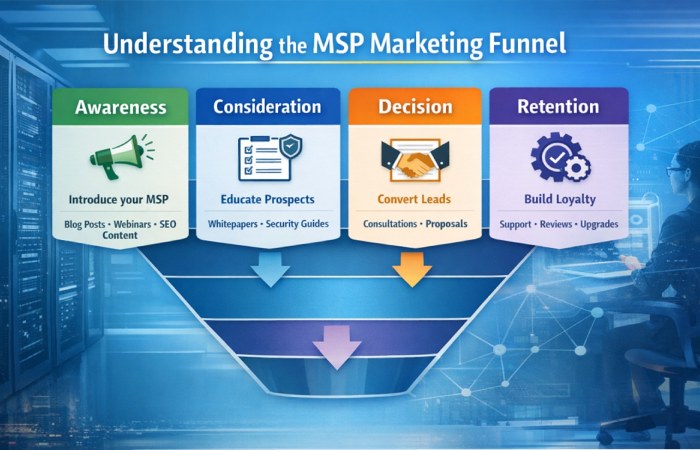
A marketing funnel represents the journey a potential client takes from discovering your company to signing a managed services agreement.
For MSP businesses, this journey often includes multiple stages because organizations must carefully evaluate providers before outsourcing their IT infrastructure.
| Funnel Stage | Objective | Typical MSP Activities |
| Awareness | Introduce your MSP to potential clients | Blog articles, webinars, SEO content |
| Consideration | Educate prospects about IT risks and solutions | whitepapers, security guides, assessments |
| Decision | Convert leads into paying clients | consultations, proposals |
| Retention | Maintain long-term relationships | support services, reviews, upgrades |
In practice, prospects move through these stages gradually. A company may discover your blog article about cybersecurity risks, download a checklist weeks later, attend a webinar, and only then request a consultation.
Research from the Forrester indicates that B2B buyers interact with multiple pieces of content before speaking with a vendor. For MSPs, this reinforces the importance of educational marketing rather than aggressive selling.
Why MSP Funnels Are Different From Generic B2B Funnels
Many marketing guides assume a simple sales process. However, MSP services involve higher risk and long-term commitments.
| Generic B2B Funnel | MSP Marketing Funnel |
| Shorter buying cycle | Longer evaluation period |
| Product-focused marketing | Trust and expertise focused |
| Often transactional sales | Long-term recurring contracts |
| Lower operational risk | High operational responsibility |
When a company hires an MSP, it effectively entrusts the provider with:
- cybersecurity protection
- network stability
- cloud infrastructure
- business continuity
If the MSP fails, the client’s entire operation could be affected. This is why the MSP funnel must emphasize authority, credibility, and reliability.
Successful MSP marketing funnels often prioritize:
- educational blog content
- industry-specific case studies
- security expertise demonstrations
- consultation-based sales processes
Define Your Ideal MSP Client Profile
One of the biggest mistakes MSPs make is trying to serve every possible type of business. A scalable marketing funnel requires a clear understanding of the ideal client.
| Industry | Why They Need MSP Services |
| Healthcare | compliance requirements and data protection |
| Legal firms | secure document management |
| Financial services | regulatory compliance |
| E-commerce | cloud infrastructure and uptime |
Defining the ideal client profile allows marketing campaigns to focus on businesses that truly benefit from managed services.
Key Elements of an Ideal Client Profile
| Factor | Description |
| Company size | typically 10–200 employees |
| IT complexity | multiple systems and users |
| Budget capacity | ability to afford recurring service contracts |
| Compliance needs | healthcare, financial, or security regulations |
Example Scenario
Consider a healthcare clinic with 40 employees. The clinic must protect patient data and comply with strict regulatory requirements. The internal staff may not have cybersecurity expertise.
An MSP that specializes in healthcare compliance becomes highly valuable to such organizations. Targeting similar companies creates a higher-quality marketing funnel with stronger conversion rates.
Build a Lead Generation Engine
A scalable marketing funnel needs consistent traffic sources feeding potential clients into the system.
| Channel | Strength | Limitation |
| SEO | long-term organic traffic | takes time to build authority |
| LinkedIn outreach | strong B2B targeting | requires consistent effort |
| Referrals | high trust | difficult to scale |
| Paid advertising | immediate traffic | higher acquisition cost |
One particularly effective approach for MSP businesses is the local authority strategy.
The Local Authority Funnel
Many companies prefer working with IT providers located nearby. Local authority marketing focuses on dominating a regional market rather than competing nationally.
| Local Authority Strategy | Benefit |
| Optimizing Google Business listing | improves local search visibility |
| Publishing regional IT guides | builds credibility with local companies |
| Partnering with consultants | creates referral networks |
| Hosting local webinars | positions MSP as community expert |
Search engines prioritize local service providers for many queries. Resources like the Google Search Central documentation highlight the importance of local optimization for service businesses.
Create High-Value Lead Magnets
Lead magnets convert anonymous visitors into identifiable leads by offering valuable resources.
For MSP businesses, the best lead magnets are usually diagnostic tools or practical guides.
| Lead Magnet | Purpose |
| Cybersecurity risk assessment | identify vulnerabilities |
| IT infrastructure checklist | evaluate existing systems |
| Compliance readiness guide | assist regulated industries |
| Cloud migration roadmap | help businesses plan upgrades |
Lead magnets work best when they solve a specific operational problem rather than offering generic marketing material.
Effective Lead Magnet Elements
| Element | Why It Matters |
| Clear value proposition | explains what the user gains |
| Simple form | reduces friction |
| Practical insights | increases perceived value |
| Follow-up content | keeps leads engaged |
Implement Email Nurturing and Automation
Most MSP prospects do not switch providers immediately. They may spend months evaluating options.
Email nurturing keeps your company visible during that evaluation process.
| Email Stage | Purpose |
| Welcome email | introduce your MSP and expertise |
| Educational emails | provide insights about security risks |
| Case studies | demonstrate successful implementations |
| Consultation invitation | encourage prospects to schedule meetings |
Marketing automation tools make it possible to manage these sequences efficiently.
| Tool Category | Examples |
| CRM platforms | HubSpot, Salesforce |
| Email automation | Mailchimp, ActiveCampaign |
| Analytics tools | Google Analytics |
According to the HubSpot marketing benchmark reports, companies using automated nurturing systems generate significantly more qualified leads than those relying on manual outreach.
Optimize Website Conversion Paths
Your website is the central hub of the marketing funnel. It should guide visitors toward the next logical step.
| Conversion Element | Purpose |
| Consultation call-to-action | encourages direct contact |
| Testimonials | builds credibility |
| Case studies | demonstrates proven results |
| Certifications | reinforces expertise |
Example Funnel Scenario
The following example illustrates how a funnel converts traffic into clients.
| Funnel Metric | Example Value |
| Monthly website visitors | 1,000 |
| Lead conversion rate | 5% |
| Consultation bookings | 10% of leads |
| Client conversion rate | 30% |
In this scenario:
- 1,000 visitors produce 50 leads
- 5 leads schedule consultations
- 1–2 leads become clients
For MSP businesses with recurring contracts, even one new client per month can significantly increase annual revenue.
Track Funnel Performance
A marketing funnel cannot improve without measurable data.
| Metric | Why It Matters |
| Cost per lead | shows marketing efficiency |
| Lead-to-client conversion rate | measures sales effectiveness |
| Customer lifetime value | determines profitability |
| Traffic source performance | identifies best channels |
Companies that track funnel metrics using CRM systems typically outperform competitors relying on manual tracking.
Research published by the McKinsey & Company indicates that data-driven organizations achieve stronger marketing ROI and more efficient customer acquisition.
More details on data-driven marketing can be found here:
https://www.mckinsey.com/capabilities/growth-marketing-and-sales
Build a Retention and Expansion Funnel
For MSP businesses, the real value often comes after the first contract is signed.
Recurring service models mean that client retention directly affects profitability.
| Retention Strategy | Benefit |
| Quarterly IT reviews | maintain strategic alignment |
| Security upgrades | increase service value |
| Cloud management services | expand recurring revenue |
| Client training sessions | strengthen relationships |
Retention-focused strategies often produce higher long-term returns than aggressive acquisition campaigns.
Common MSP Marketing Funnel Mistakes
Even well-designed funnels can fail if common mistakes occur.
| Mistake | Impact |
| relying only on referrals | limits growth potential |
| ignoring SEO | reduces online visibility |
| weak lead nurturing | prospects lose interest |
| no performance tracking | prevents optimization |
Avoiding these mistakes ensures the marketing funnel remains effective and scalable.
Final Thoughts
A scalable marketing funnel transforms MSP marketing from a relationship-driven activity into a structured growth system. In modern B2B markets, companies often research solutions across many channels before contacting a vendor, which makes consistent education and trust-building essential. Studies on B2B buying behavior show that marketing funnels help guide prospects through complex decision processes by delivering the right information at each stage of the journey