

Social media drives real business growth only when managed as a structured acquisition and conversion system—not as random content posting. Treat it as a measurable funnel that transforms attention into revenue.
Most businesses are active on social media but struggle to translate activity into sales. Posts generate likes, shares, and occasional bursts of attention, yet revenue barely moves. The core problem is not effort—it’s lack of strategy. Random posting creates noise, not momentum.
When social media is treated as a full-funnel growth engine, results change dramatically. You attract the right audience, build trust systematically, guide prospects toward action, and measure what actually drives profit. In short: social media grows businesses when it is operated like a marketing system, not a hobby.
How to Utilize Social Media for Marketing
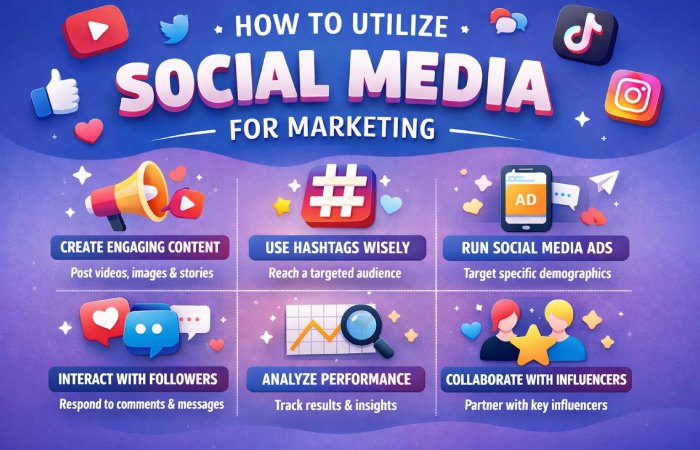
Social media marketing is most effective when it moves prospects through a deliberate journey—from discovery to purchase to loyalty.
| Stage | Objective | What to Do |
| Awareness | Reach new audiences | Short videos, educational posts |
| Interest | Build credibility | Guides, insights, tutorials |
| Consideration | Show proof | Case studies, demos |
| Conversion | Drive action | Offers, booking links |
| Retention | Build loyalty | Community content |
Marketing authorities such as the Content Marketing Institute consistently emphasize that helpful content—not aggressive promotion—is what attracts and retains modern buyers.
Practical example:
A fitness coach posting workout tips builds awareness; offering a free training plan captures leads; personalized coaching converts those leads into paying clients.
How Does Social Media Help Businesses
Social media’s impact is supported by extensive research across industries.
| Business Benefit | What Studies Consistently Show | Practical Meaning |
| Brand awareness | Massive global reach | Essential for visibility |
| Customer engagement | Direct interaction | Builds trust faster |
| Lead generation | Effective with targeted content | Requires funnel |
| Market insights | Real-time feedback | Improves decisions |
| Cost efficiency | Lower entry cost than many channels | Time-intensive |
Data frequently reported by the Pew Research Center and Statista shows that most internet users participate in social platforms, making them one of the largest accessible audiences in history.
However, access to audiences does not guarantee conversions—strategy determines profitability.
Positive and Negative Impact of Social Media on Business
Social media can accelerate growth or amplify problems depending on how it is used.
Positive Impacts
| Advantage | Why It Matters |
| Global reach | Customers beyond local markets |
| Direct communication | Faster relationship building |
| Brand authority | Establishes expertise |
| Customer insights | Immediate feedback |
| Low barrier to entry | Accessible to small businesses |
Negative Impacts
| Risk | Potential Consequence |
| Public criticism | Reputation damage |
| Algorithm changes | Unpredictable reach |
| Time demands | Resource strain |
| Content saturation | Hard to stand out |
| Misinformation | Loss of trust |
Research commonly cited by the Nielsen highlights how strongly peer opinions influence purchasing decisions—positively or negatively.
The same mechanism that spreads praise can rapidly spread complaints.
Best Social Media to Promote Business
There is no universally “best” platform—only the best platform for your audience and business model.
| Platform | Strength | Best For |
| Visual discovery | Fashion, food, lifestyle | |
| Professional trust | B2B services, consulting | |
| TikTok | Rapid reach | Consumer brands |
| YouTube | Deep research | Education, tech, reviews |
| Community groups | Local businesses |
Data frequently reported by nrz.com.au The first step is identifying the platforms where your target audience spends their time. Choose the platform where your customers actively seek information related to your offering—not where competitors are loudest.
Social Media Business Communication
Social media has evolved into a primary communication channel between businesses and stakeholders.
Customer Communication
| Purpose | Examples |
| Support | Answering questions, resolving issues |
| Updates | Announcements, changes |
| Education | How-to content |
| Relationship building | Thank-you posts, stories |
Brand & Reputation Communication
- Crisis responses
- Public relations updates
- Employer branding
- Industry engagement
Fast, transparent responses often turn dissatisfied customers into loyal advocates.
Craft a Strong Brand Position and Message
People follow clarity, not companies.
A compelling position communicates instantly:
- Who you help
- What problem you solve
- Why you are different
Without clear positioning, even high-quality content fails to resonate.
Simple positioning template
We help [specific audience] achieve [specific result] without [major pain point].
Build a High-Impact Content Strategy
Most successful brands prioritize value over promotion.
| Content Type | Purpose | Impact |
| Educational | Teach or solve problems | Builds trust |
| Engagement | Encourage interaction | Builds community |
| Promotional | Sell products/services | Generates revenue |
Value builds attention; trust enables conversion.
Optimize Content for Algorithms AND Humans
Algorithms amplify content that keeps users engaged.
High-performing posts usually include:
- A strong opening hook
- Clear single message
- Compelling visuals
- Relatable storytelling
- Direct call to action
Human psychology drives algorithmic success.
Grow Engagement Into Community
An audience consumes content; a community participates in it.
Community-building tactics:
- Responding thoughtfully to comments
- Asking for opinions
- Featuring user stories
- Hosting live sessions
- Encouraging user-generated content
Communities generate organic growth through advocacy.
Use Social Proof to Accelerate Trust
People trust people more than brands.
| Proof Type | Effect on Buyers |
| Testimonials | Reduces perceived risk |
| Case studies | Shows real outcomes |
| User content | Demonstrates authenticity |
| Media features | Signals authority |
Trust shortens decision time and reduces price resistance.
Turn Attention Into Leads and Sales
Without a funnel, attention rarely converts into revenue.
| Stage | Goal | Tools |
| Awareness | Attract prospects | Social content |
| Interest | Educate | Guides, videos |
| Consideration | Build confidence | Testimonials, demos |
| Conversion | Trigger purchase | Offers, trials |
| Retention | Increase lifetime value | Community, email |
Amplify Results with Paid Advertising
Advertising is most effective when scaling proven content.
Recommended sequence:
- Test organically
- Identify top performers
- Promote to targeted audiences
- Retarget engaged users
- Optimize for conversions
This reduces wasted ad spend.
Measure What Actually Drives Growth
Vanity metrics can create false confidence.
| Metric | Why It Matters |
| Engagement rate | Content relevance |
| Clicks | Purchase intent |
| Leads | Pipeline health |
| Customer acquisition cost | Profitability |
| Repeat engagement | Loyalty |
Tracking should connect social activity to business results.
Common Mistakes That Limit Business Growth
- Posting without clear goals
- Chasing trends unrelated to your audience
- Over-promoting too early
- Ignoring analytics
- Inconsistent messaging
Avoiding these errors often produces faster improvement than adopting new tactics.
30-Day Action Plan to Start Seeing Results
| Week | Focus | Key Actions |
| Week 1 | Strategy | Define audience and goals |
| Week 2 | Content | Create core value posts |
| Week 3 | Engagement | Interact and collaborate |
| Week 4 | Optimization | Analyze and refine |
Conclusion
When used as an organized system and not a flow of posts, social media can be an open source of business expansion. Clarity and clarity of goals will help in attracting the appropriate audience, valuable content will help in creating trust, community will help in strengthening relationships and funnels will turn attention into revenue.
Companies that do this cycle have always failed to merely acquire followers but have created sustainable competitive advantage in a world that has become attention-seeking.