

Have you ever considered how quickly a company can grow without starting from scratch? Finding the right opportunity can make all the difference. For tech businesses, one effective method for scaling quickly is through acquisitions of smaller firms. SaaS companies for sale represent an ideal way to quickly expand your portfolios.
Understanding the Acquisition of Small Tech Companies
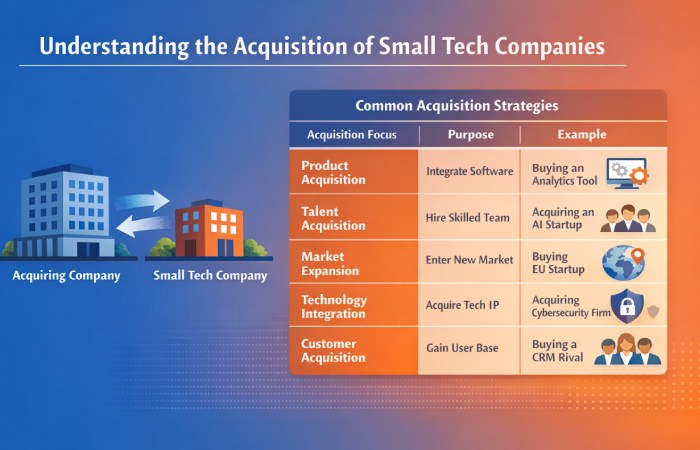
When a business acquires a small technology company, it purchases ownership of that company’s assets, which may include software products, intellectual property, development teams, customer relationships, and operational systems. The acquiring company then integrates these assets into its own business strategy.
Unlike traditional mergers between large corporations, acquisitions involving small tech companies often focus on specific strategic advantages. Sometimes the buyer is interested primarily in the technology itself. In other cases, the most valuable asset is the startup’s engineering talent or its presence in a particular market niche.
These acquisitions usually fall into several common strategic categories.
| Acquisition Focus | Purpose | Example Scenario |
| Product acquisition | Integrate a software product into an existing platform | A SaaS company buys a niche analytics tool |
| Talent acquisition | Secure a highly skilled engineering team | A large company acquires an AI startup |
| Market expansion | Enter a new geographic or industry market | A US tech firm buys a regional European startup |
| Technology integration | Gain proprietary technology | A cybersecurity firm acquires a threat detection startup |
| Customer acquisition | Expand user base | A CRM platform buys a smaller competitor |
Each of these strategies reflects the broader goal of gaining capabilities that would be difficult or time-consuming to build internally.
Why Small Tech Companies Are Attractive Targets
One of the main reasons small tech companies are appealing acquisition targets is their ability to innovate quickly. Startups typically operate with small teams and streamlined decision-making processes. This allows them to experiment with new ideas and develop products faster than larger corporations.
Large companies, by contrast, often face internal bureaucracy, complex approval processes, and slower development cycles. By acquiring startups that have already developed innovative solutions, larger firms can accelerate their own innovation timelines.
The difference between startup agility and corporate structure is often clear when comparing how the two operate.
| Innovation Factor | Small Tech Companies | Large Corporations |
| Development speed | Rapid iteration | Slower development cycles |
| Decision making | Flexible and quick | Structured and hierarchical |
| Risk tolerance | High experimentation | More conservative |
| Adaptability | Very responsive | Often slower to change |
Because of these differences, acquisitions allow larger organizations to combine their resources and distribution power with the agility of startups.
The Value of Specialized Talent
Another important factor driving acquisitions is access to specialized talent. In the technology sector, experienced engineers and developers with expertise in emerging fields are extremely valuable. Hiring individuals with these skills can be difficult and time-consuming, especially in competitive areas such as artificial intelligence, cybersecurity, and cloud computing.
When companies acquire small startups, they often gain an entire team of engineers who have already demonstrated the ability to work together effectively. This approach is commonly referred to as acqui-hiring.
Rather than recruiting developers individually, organizations acquire the entire company and integrate its team into their existing workforce. This strategy allows them to quickly strengthen their technical capabilities while also gaining valuable institutional knowledge about the technology the team has built.
Immediate Market Access and Customer Growth
Acquisitions also offer an efficient way for companies to expand into new markets. Entering a new geographic region or industry sector can require years of marketing, relationship building, and regulatory navigation. However, purchasing a company that already operates in that market can significantly reduce these barriers.
Small tech companies often have established customer relationships, brand recognition within niche communities, and partnerships that would otherwise take years to develop. By acquiring these businesses, larger companies gain access to these networks almost instantly.
| Market Expansion Advantage | Business Impact |
| Existing customers | Immediate revenue potential |
| Local market knowledge | Faster adaptation to new regions |
| Established reputation | Reduced marketing effort |
| Partner networks | Easier ecosystem integration |
These advantages make acquisitions a powerful strategy for organizations seeking rapid expansion.
The Influence of Venture Capital and Startup Ecosystems
The growth of venture capital and startup ecosystems has also contributed to the increasing number of acquisitions. Venture capital firms fund early-stage startups with the expectation that these companies will eventually provide a return on investment. In many cases, the most likely outcome is acquisition by a larger company.
Although some startups pursue public listings, acquisitions remain the most common exit strategy. When a larger company purchases a startup, investors and founders receive returns on their initial investment, while the acquiring company gains access to the startup’s assets and innovations.
| Startup Exit Strategy | Typical Outcome |
| Acquisition | Purchased by a larger company |
| Initial public offering | Company becomes publicly traded |
| Private equity sale | Investment firms buy majority ownership |
This ecosystem creates a continuous pipeline of startups that may eventually become acquisition targets.
The Rise of Micro-SaaS and Niche Software Companies
Another factor contributing to the rise in acquisitions is the increasing number of micro-SaaS businesses. These companies typically focus on solving very specific problems for a defined group of users.
Instead of building large platforms, many entrepreneurs now create small software products designed to serve niche markets. Although these businesses may start with relatively small teams, they can become highly valuable because they address specialized needs within larger technology ecosystems.
Large companies often acquire these niche solutions to enhance their own platforms. Integrating a specialized tool into a broader software ecosystem can increase the value of the entire product suite while improving the user experience.
For example, a project management platform might acquire a small startup that has built an innovative workflow automation tool. By integrating this feature, the acquiring company strengthens its product offering and differentiates itself from competitors.
Strategic Benefits of Tech Acquisitions
From a strategic perspective, acquiring small technology companies provides several advantages for growing organizations. Instead of investing years into research and development, companies can accelerate their progress by integrating existing technologies.
The benefits of this strategy often include faster product development, improved competitive positioning, and expanded market reach.
| Strategic Benefit | Explanation |
| Faster growth | Companies scale more quickly through acquisitions |
| Technology access | Immediate integration of innovative solutions |
| Talent acquisition | Skilled engineering teams join the organization |
| Market entry | Businesses expand into new regions or sectors |
| Competitive protection | Potential rivals are absorbed before they grow |
These advantages explain why acquisitions have become a central part of many technology companies’ growth strategies.
Challenges and Risks in Tech Acquisitions
Despite the many advantages, acquisitions are not always successful. Integrating a small startup into a larger organization can create challenges related to culture, technology compatibility, and long-term strategy.
Startups often operate with informal cultures and rapid decision-making processes. When they become part of a larger corporation, employees may struggle to adapt to more structured environments. In some cases, key team members leave shortly after the acquisition, reducing the value of the deal.
Technology integration can also be complicated. Software platforms may rely on different programming languages, infrastructure systems, or development frameworks, making it difficult to merge them into a single product ecosystem.
| Common Acquisition Risk | Description |
| Cultural differences | Startup culture may clash with corporate processes |
| Technical integration issues | Systems may not easily connect |
| Talent retention problems | Founders or engineers may leave |
| Strategic misalignment | Acquisition may not support long-term goals |
Because of these challenges, successful acquisitions require careful planning, clear communication, and strong leadership.
Why Individual Entrepreneurs Are Buying Tech Businesses
In addition to corporations and investors, individual entrepreneurs are increasingly interested in acquiring small tech companies. Rather than building startups from the ground up, some founders prefer to purchase existing digital businesses that already generate revenue.
These businesses may include SaaS platforms, mobile applications, and niche software products. The advantage of this approach is that the product has already been developed and tested in the market. Buyers can focus on scaling and improving the business instead of starting from zero.
For entrepreneurs with strong marketing, product management, or operational skills, acquiring an existing technology company can be a practical path to entering the software industry.
Future Trends in Small Tech Company Acquisitions
The appeal of acquiring small tech companies is likely to grow in the coming years. As digital transformation continues across industries, organizations will increasingly seek innovative technologies that help them remain competitive.
Emerging technologies such as artificial intelligence, automation, and advanced data analytics will likely create new waves of startup activity. Many of these startups will eventually become acquisition targets for larger companies seeking to expand their capabilities.
| Key Future Driver | Potential Impact |
| Artificial intelligence innovation | Increased demand for specialized startups |
| Global digital transformation | More companies seeking technology solutions |
| Expansion of startup ecosystems | Larger pool of acquisition targets |
| Private equity investment | Greater availability of capital for acquisitions |
These trends suggest that acquisitions will remain a major mechanism through which innovation spreads across the technology industry.
Conclusion
The growing appeal of acquiring small tech companies reflects a broader shift in how businesses innovate and expand in the modern economy. Instead of relying solely on internal development, organizations are increasingly turning to acquisitions as a faster and more efficient way to gain technology, talent, and market access.
For startups, this environment creates opportunities to build highly specialized solutions that may attract strategic buyers. For larger organizations, acquiring these startups provides a powerful way to accelerate innovation and strengthen competitive positioning.